Dear Therapist, Love Notion: An Open Letter on Turning Practice Chaos Into a System
Dear Therapist,
It's Notion. We've met before, usually around 11pm when you're trying to remember exactly how you handle a no-show, and the answer currently lives entirely in your head.
Here's a question for you: if you got the flu tomorrow and your admin person had to cover for a week, could she find your process for a client crisis? Your no-show policy? Your referral-out script? Or would she have to text you while you're lying on the couch with a thermometer in your mouth?
If the answer is "she'd have to text me," we need to talk.
This is exactly what a Standard Operating Procedure, or SOP, is for. Not the scary corporate binder kind. Just a clear, written-down version of "here's how we do this thing," so it doesn't have to live only in your brain. And I happen to be a genuinely great place to build them.
The best part? You don't need a paid plan, an elaborate template, or a weekend retreat to make this happen. You need about an hour and a plan. Let's build it.
What Actually Counts as an SOP (It's Simpler Than You Think)
An SOP is just the answer to: "if I had to explain this process to someone new, step by step, what would I say?"
For a private practice, the highest-value SOPs usually cover:
Client onboarding (from inquiry to first session)
No-shows and late cancellations
Crisis or safety concerns
Referring out (to another provider, a higher level of care, or a specialist)
Termination and discharge
Insurance and billing hiccups (denied claims, coordination of benefits)
You don't need to write all six this week. Pick the one that causes you the most stress or repeated confusion, and start there.
Set Up a Simple SOP Library (Free Plan Friendly)
Here's a structure that works whether you're solo or running a small group practice, and it fits comfortably on Notion's free plan.
Step 1: Create a parent page called "Practice SOPs."
This becomes your single source of truth. If it's not in here, it's not official practice policy yet.
Step 2: Build a database (table view) inside it with these properties:
SOP Name
Category (Clinical, Admin, Billing, Marketing)
Last Updated
Owner (you, or whoever maintains it)
Status (Draft, Active, Needs Review)
This turns your SOP library into something you can actually filter and sort, instead of a pile of documents with no organization.
Step 3: Each SOP gets its own page, with this simple format inside:
Policy summary — one or two sentences on what this policy is and why it exists
Step-by-step process — numbered, not paragraphs, so it can be followed under stress
Scripts or templates — exact wording for emails, texts, or things you say out loud
Exceptions — the "but what if" scenarios you already know come up
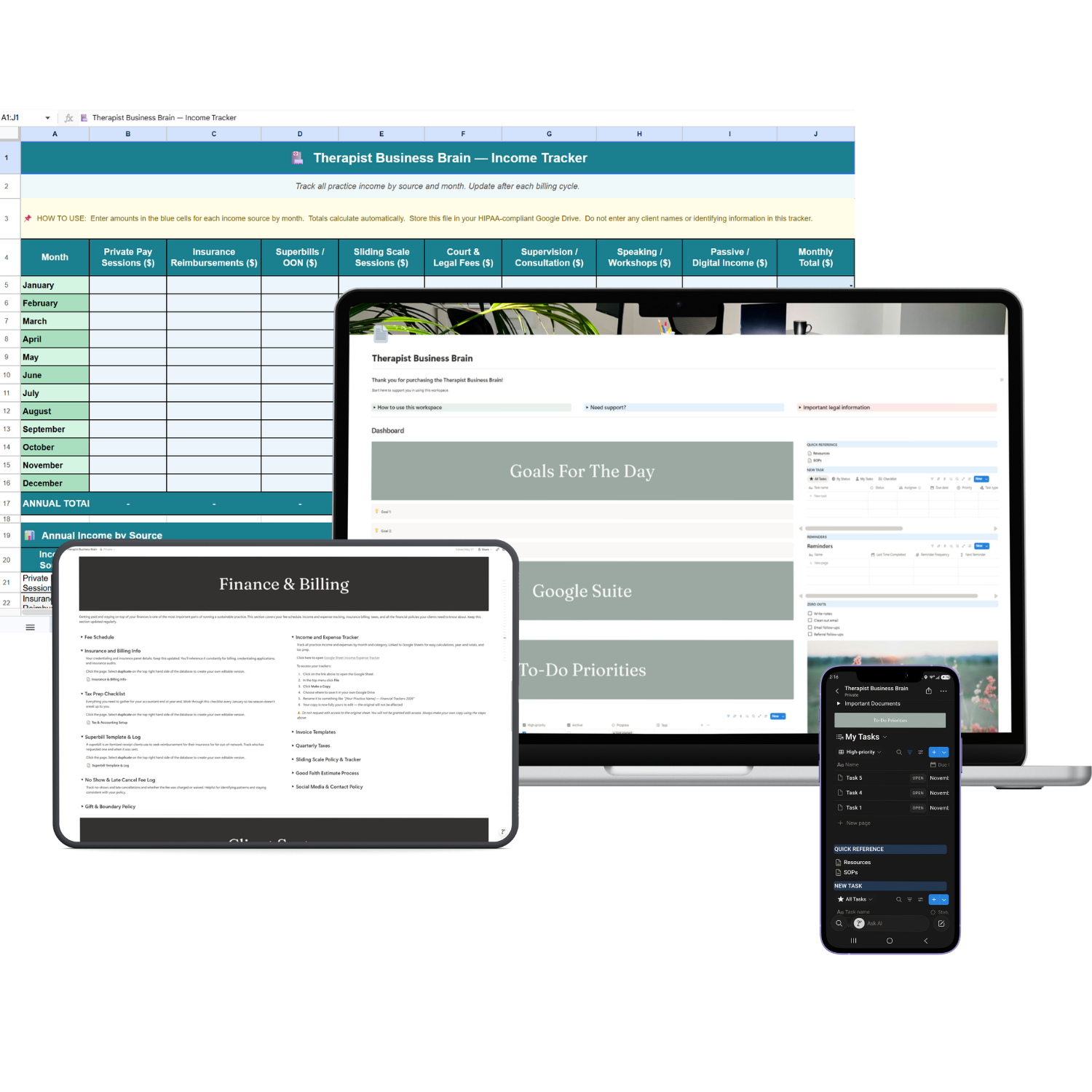
Looking for a Done-For-You ENTIRE business brain?
The Therapist Business Brain is everything you need and more.
Worked Example: The No-Show and Cancellation SOP
Let's actually build one together, since this is one of the most commonly needed (and most commonly missing) SOPs in a practice.
Policy summary:
Clients who no-show or cancel with less than 24 hours' notice are charged the full session fee, except in cases of documented emergency. This policy is communicated at intake and reinforced in the confirmation reminder.
Step-by-step process:
Client no-shows or cancels late.
Check the client's file for prior no-shows this quarter.
If this is a first occurrence, send the "first no-show" message template (below), noting the fee.
If this is a second or third occurrence, send the "pattern" message template and flag for a policy conversation at the next session.
Log the occurrence in the client's file, including date and any relevant context.
Process the fee through your billing system.
Message templates:
First occurrence: "Hi [Name], I wanted to check in since we had our session scheduled for [date/time] and I didn't hear from you. Per our cancellation policy, a fee of [$amount] applies for missed sessions without 24 hours' notice. Let me know if there was an emergency I should be aware of, and I hope to see you at our next scheduled time."
Exceptions:
Documented medical emergencies, weather closures, or provider-initiated cancellations do not incur a fee.
Once this is written down once, it never has to be re-decided from scratch, and if you ever bring on an associate, you can hand them this page instead of your entire mental model of how you run your practice.
Turn Your SOPs Into Practice-Wide Muscle Memory
Writing the SOP is only step one. The real win is when it's actually used instead of quietly living in a page nobody opens again.
A few ways to make that happen:
Link relevant SOPs directly from your client management templates. If you use Notion for light CRM or client tracking, add a linked reference to the no-show SOP right on the client's page.
Set a recurring "SOP Review" task (monthly or quarterly) to check whether anything needs updating. Insurance panels change. Policies evolve. Stale SOPs are almost worse than none, because people trust them and then get burned.
Bring in associates or admin staff during onboarding, not as an afterthought. Your SOP library should be one of the first things a new team member reads, not something you explain verbally and hope they remember.
A Note on What Notion Isn't
I'll be straightforward with you here, because that's the whole point of this letter: I am not an EHR, and I'm not a substitute for HIPAA-compliant clinical documentation software. Progress notes, treatment plans, and anything requiring strict clinical documentation standards should stay in your EHR.
What I'm genuinely great for is the operational layer around your clinical work: policies, processes, templates, and the administrative backbone that keeps a practice running smoothly. Keep that boundary clear and we'll get along great.
Your First SOP, Start to Finish
If you want to actually do this instead of just nodding along, here's your homework:
Pick one process that currently exists only in your head.
Create your "Practice SOPs" parent page (if you don't have one yet).
Write the policy summary in one to two sentences.
List the steps in order, numbered.
Draft any scripts or message templates you'll actually reuse.
Set a review date three months out.
That's it. One SOP, one hour, and your practice runs a little less on vibes and a little more on a system.
With love (and zero judgment about the seventeen half-finished databases in your workspace),
Notion
Want more practice operations tips? Check out these posts next: